Proximity3D: Shape from Capacitive Proximity on Sensing Manifold
SIGGRAPH Asia 2026
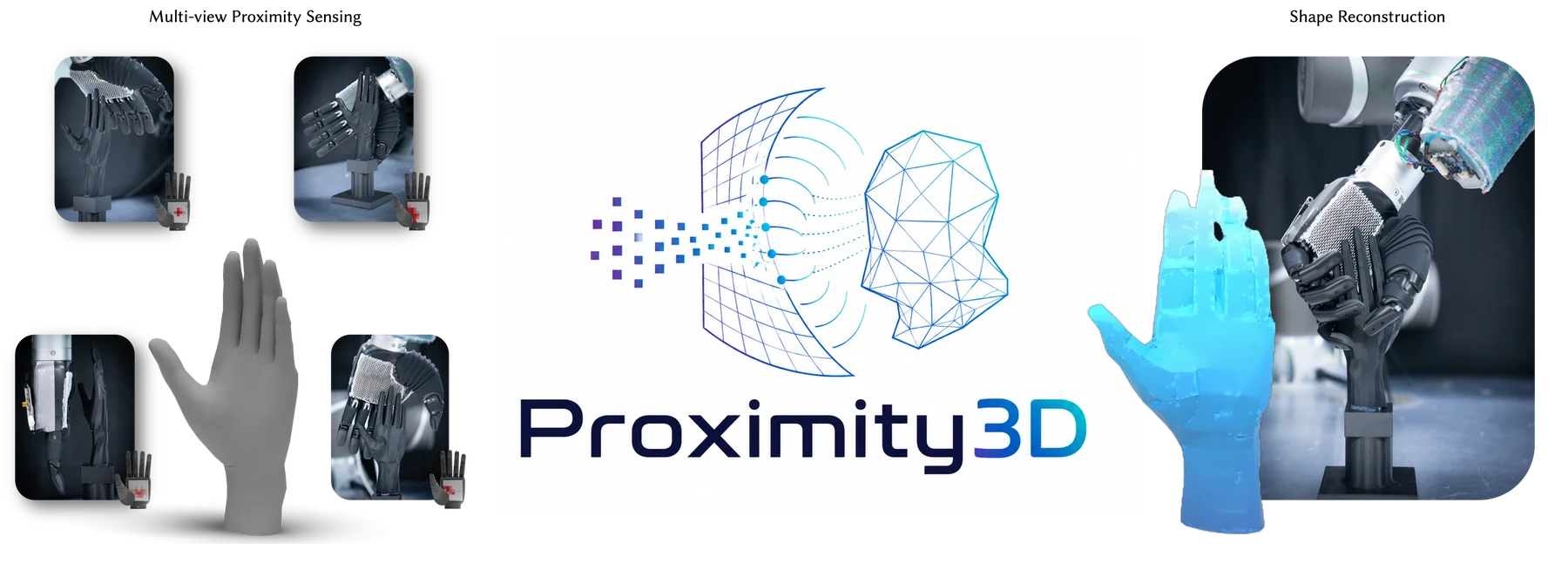
Fast-Forward Video
Abstract
Most shape reconstruction methods assume measurements defined over planar sensing domains, such as RGB images or depth maps. In this paper, we use a curved capacitive textile as a shape sensor, treating its surface as a non-planar sensing manifold. Each scan is represented as a capacitive proximity field on this manifold, induced by the interaction between the curved electrode layout and nearby object geometry.
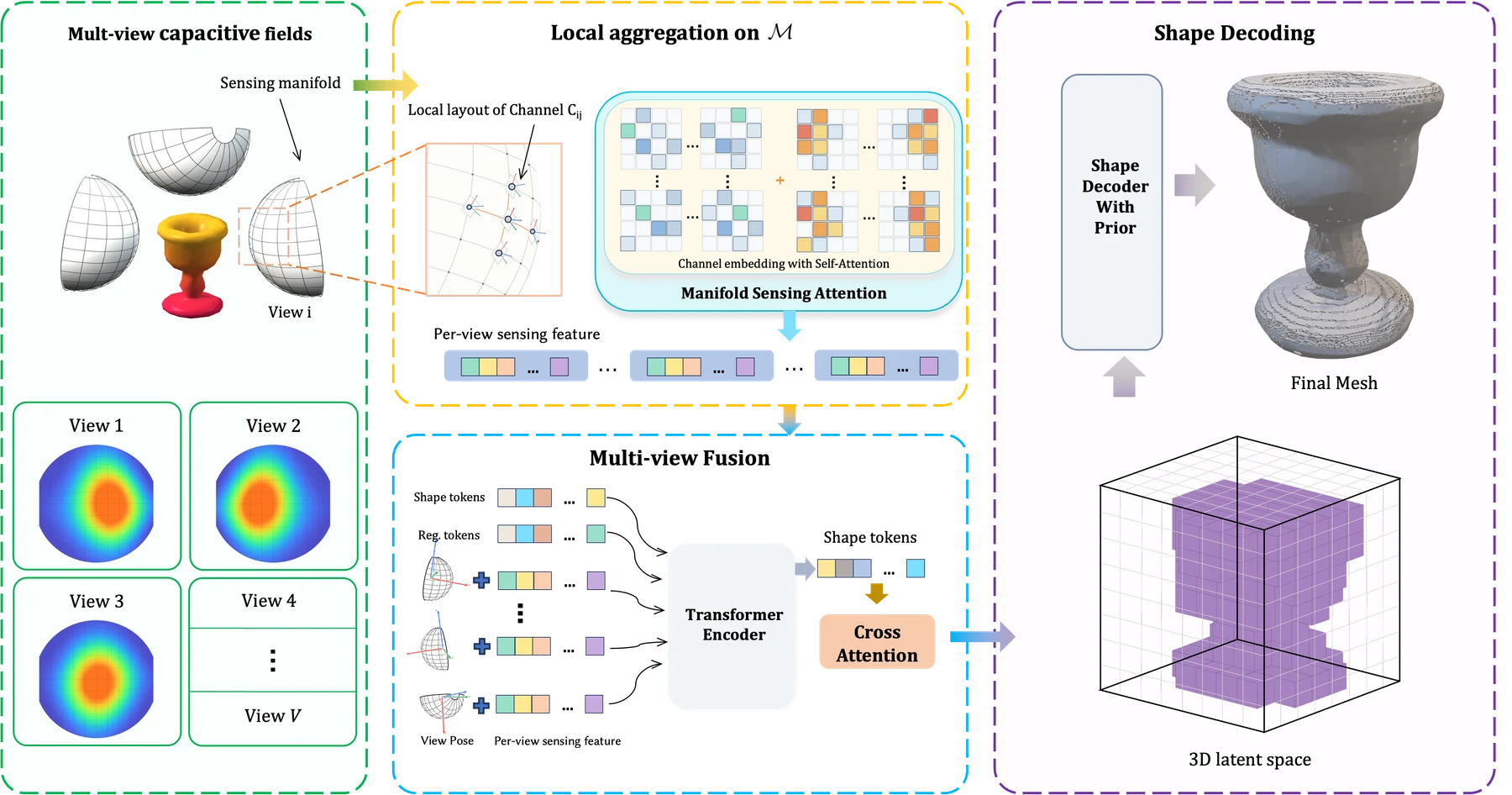
We introduce a multi-view feedforward reconstruction model that aggregates these fields across known sensor views and recovers the observed object shape. Simulated and physical experiments demonstrate robust reconstruction from capacitive proximity signals acquired on curved sensing surfaces, pointing toward a new route to robotic near-field geometric awareness via embodied sensing.
Capacitive Proximity on a Sensing Manifold
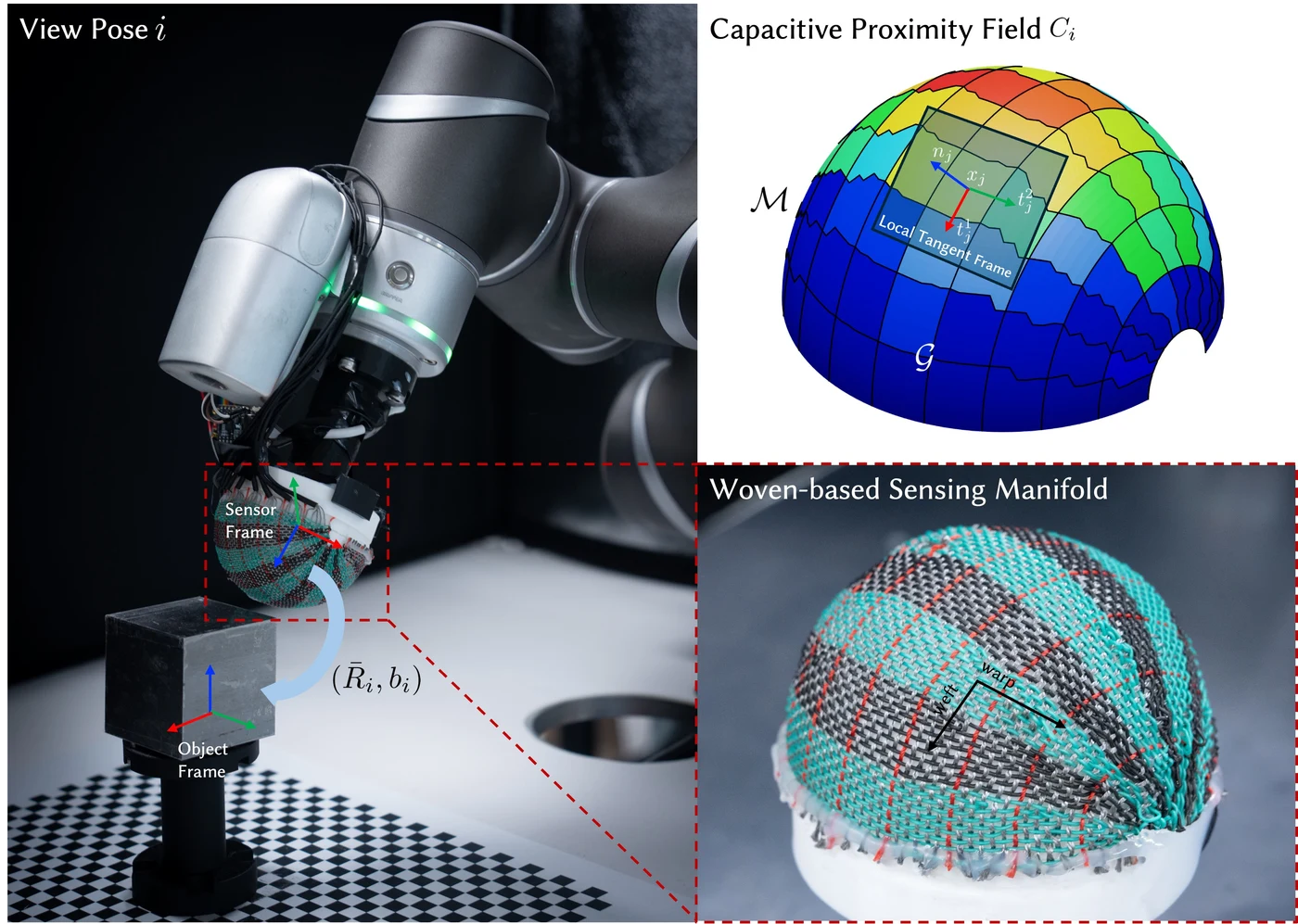
A woven capacitive textile conforms to a curved surface. Each channel has a known site, local electrode frame, and adjacency relation, providing the geometric structure used by the reconstruction model.
Method
Simulated Reconstruction Results
Ground Truth
Reconstruction
Real-World Results
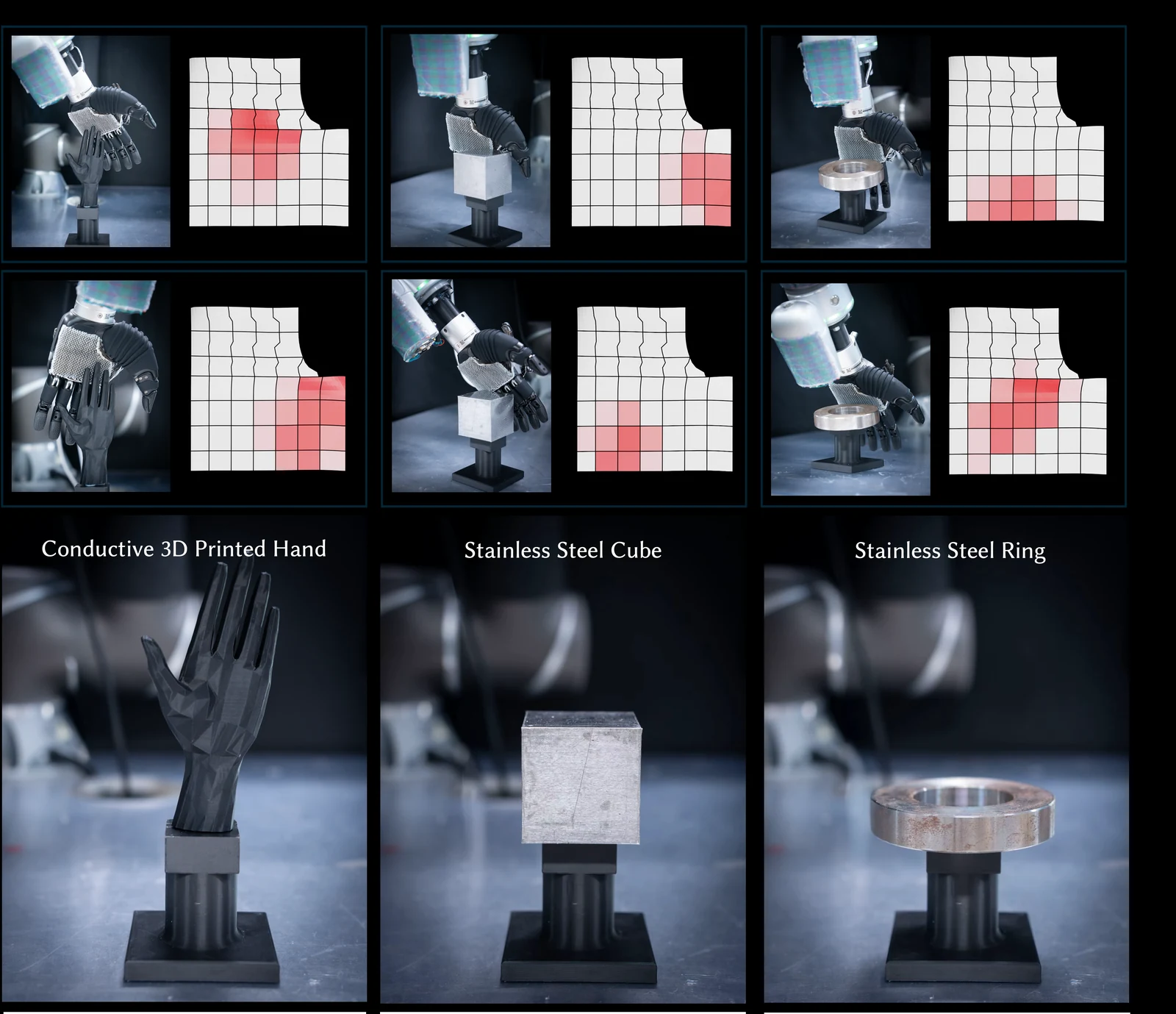
The woven sensing manifold acquires multi-view proximity signals around each physical target, which Proximity3D uses to reconstruct the object mesh. The figure below is a schematic illustration of the real-world sensing process.
BibTeX
@misc{chen2026proximity3dshapecapacitiveproximity,
  title = {Proximity3D: Shape from Capacitive Proximity on Sensing Manifold},
  author = {Hao Chen and Chenming Wu and Chun Ping Lam and Xiangjia Chen and
            Guoxin Fang and Charlie C. L. Wang and Yeung Yam and Juncong Lin and
            Chengkai Dai},
  year = {2026},
  eprint = {2608.30344},
  archivePrefix = {arXiv},
  primaryClass = {cs.CV},
  url = {https://arxiv.org/abs/2608.30344}
}